
Professional Dissertation Data Analysis Help
Interpreting research data requires more than statistical knowledge—it demands an understanding of your research objectives, methodology, and university expectations. At Infig Assignment Help, we provide professional dissertation data analysis help for students who need accurate quantitative, qualitative, or mixed-method analysis for their dissertation writing. Our experts assist with selecting suitable analytical methods, performing statistical tests, interpreting findings, and presenting results in a clear academic format. From undergraduate dissertations to PhD research, our dissertation data analysis services are tailored to your subject, research design, and institutional guidelines.
Fast help, flawless results
50% OFFWhat Is Dissertation Data Analysis? Why Is It Important?
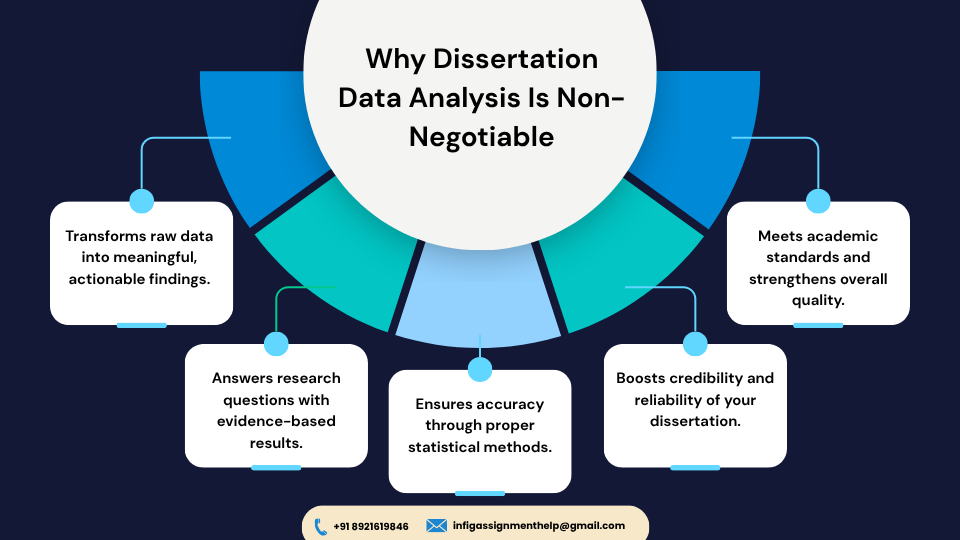
Why Choose Our Professional Dissertation Data Analysis Writing Services?
With years of experience supporting students across universities worldwide, Infig Assignment Help provides reliable academic assistance backed by subject specialists, statistical expertise, and rigorous quality checks. We focus on producing accurate analyses that align with your research methodology and university expectations.
Subject-Specific Experts
Every project is handled by professionals familiar with your discipline, research methodology, and statistical requirements.
Data Cleaning & Management
Before analysis begins, we review your dataset for missing values, duplicate entries, coding inconsistencies, and outliers. Proper data cleaning improves the reliability and validity of research findings while reducing analytical errors.
Statistical Software Expertise
Our analysts work with industry-recognised software including SPSS, AMOS, R, Stata, SAS, SmartPLS, Python, NVivo, MAXQDA, Excel, and MATLAB to perform accurate statistical and qualitative analysis.
Accurate Interpretation
We don't simply generate outputs—we explain what the results mean, relate them to your research objectives, and present findings using academically accepted language.
Our Excellence in Numbers
Academic Projects Supported
250+
Subject Specialists
100+
Academic Disciplines Covered
24/7
Student Support
What Is Statistical Help for Dissertation?

- Descriptive Statistics
- Inferential Statistics
- Correlation Analysis
- Linear & Multiple Regression
- Logistic Regression
- Independent & Paired Sample t-tests
- ANOVA & MANOVA
- ANCOVA
- Chi-Square Analysis
- Factor Analysis
- Principal Component Analysis (PCA)
- Statistical Interpretation & Reporting
- Data Visualisation
- Reliability Analysis
- Validity Testing
- Cronbach’s Alpha
- Structural Equation Modelling (SEM)
- Partial Least Squares SEM (PLS-SEM)
- Mediation & Moderation Analysis
- Time Series Analysis
- Hypothesis Testing
- Sample Size Determination
We Help with Every Type of Dissertation Data Analysis
Quantitative Data Analysis
We assist with:
- Survey Data Analysis
- Experimental Data Analysis
- Regression Models
- Correlation Studies
- Predictive Analysis
- Comparative Analysis
- Statistical Modelling
- Hypothesis Testing
- Descriptive & Inferential Statistics
- SEM & PLS-SEM
Students seeking guidance on dissertation quantitative data analysis receive complete support, from data preparation to interpretation of statistical outputs.
Qualitative Data Analysis
We also support qualitative research through:
- Thematic Analysis
- Content Analysis
- Narrative Analysis
- Framework Analysis
- Grounded Theory Coding
- Phenomenological Analysis
- Interview Data Analysis
- Focus Group Analysis
- Case Study Analysis
- NVivo & MAXQDA Coding
If you need assistance with qualitative data analysis dissertation, our experts help organise, code, interpret, and present qualitative findings in a structured academic format.
Mixed-Methods Research
For dissertations combining quantitative and qualitative research, we integrate both analytical approaches while maintaining consistency across methodology, findings, and discussion chapters.
Major Subjects We Provide Help with Dissertation Data Analysis
Business & Management
Marketing, Human Resource Management, Finance, Accounting, Operations Management, Supply Chain Management, Entrepreneurship, International Business and Project Management.
Healthcare & Medical Sciences
Nursing, Public Health, Medicine, Pharmacy, Clinical Research, Healthcare Management, Epidemiology and Nutrition.
Social Sciences
Psychology, Sociology, Education, Political Science, Social Work, Criminology and Anthropology.
Engineering & Technology
Computer Science, Artificial Intelligence, Information Technology, Cyber Security, Data Science, Mechanical Engineering, Civil Engineering and Electrical Engineering.
Science
Biology, Chemistry, Physics, Environmental Science, Biotechnology, Agriculture and Mathematics.
Other Disciplines
Hospitality Management, Tourism, Law, Economics, Media Studies, Communication, Architecture and many more.
Each analysis is completed using methods commonly accepted within your specific academic discipline.
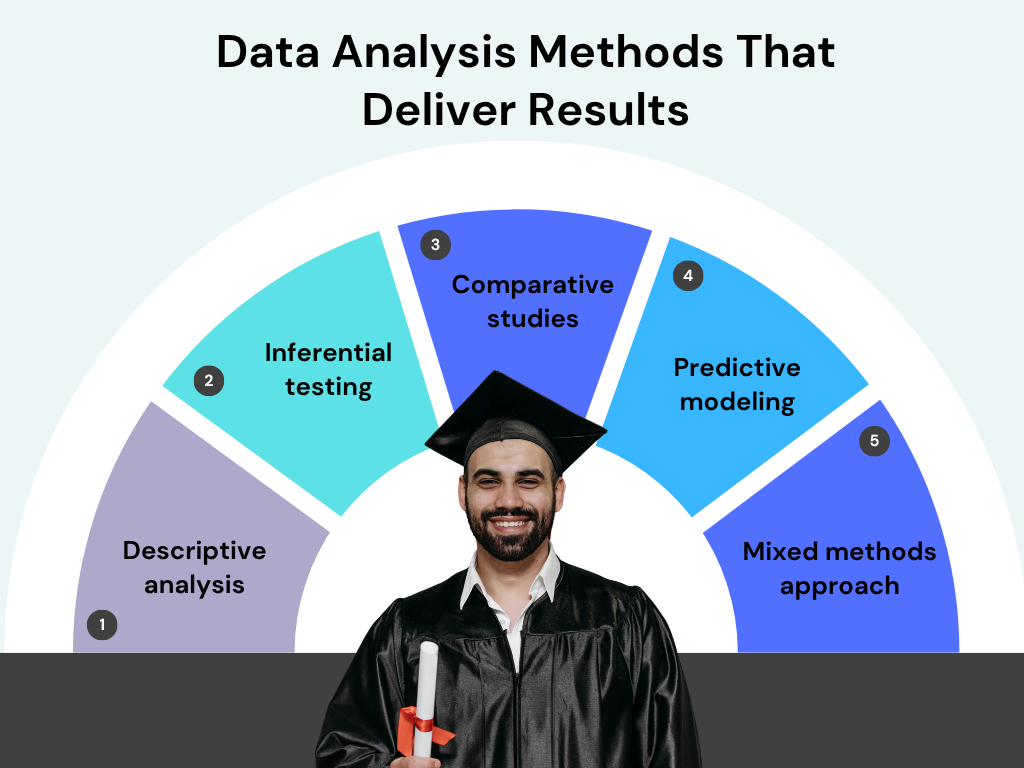
Dissertation Data Analysis Methods We Use
- Descriptive Analysis
- Inferential Analysis
- Comparative Analysis
- Exploratory Data Analysis
- Predictive Analysis
- Statistical Modelling
- Multivariate Analysis
- Longitudinal Analysis
- Cross-sectional Analysis
- Mixed Methods Analysis
If you’re unsure how to do data analysis for dissertation, our specialists evaluate your research methodology and recommend the most suitable approach.
Major Statistical Software We Use for Data Analysis Services for Dissertation
Using appropriate software improves the accuracy and reliability of research findings. Our team works with leading statistical and qualitative analysis tools to suit different research methodologies.
Statistical Analysis Software
- SPSS
- R
- Stata
- SAS
- Jamovi
- JASP
- Minitab
Structural Equation Modelling
- AMOS
- SmartPLS
Programming & Advanced Analytics
- Python
- MATLAB
Qualitative Data Analysis
- NVivo
- MAXQDA
Data Management & Visualisation
- Microsoft Excel
- Power BI
Process Involved in Our Data Analysis Service for Dissertation
Our workflow is designed to ensure every analysis is accurate, well-documented, and aligned with your university’s academic requirements.
Step 1: Share Your Research Requirements
Send us your dissertation topic, research proposal, research questions, hypotheses, methodology, dataset, questionnaire, interview transcripts, supervisor guidelines, and any university instructions. Our team reviews every detail before recommending the most appropriate analytical approach.
Step 2: Expert Review and Data Analysis
Your project is assigned to a subject-specific analyst experienced in your research methodology. The dataset is cleaned, validated, and analysed using suitable statistical or qualitative software. Every test is selected based on your research objectives, variables, and sampling method.
Step 3: Interpretation and Quality Review
After completing the analysis, our experts prepare clear interpretations supported by tables, charts, and statistical outputs. The work is then reviewed for accuracy, formatting, referencing, grammar, and consistency to ensure it meets academic standards.
Step 4: Final Delivery and Revision Support
You receive the completed analysis, supporting files, statistical outputs, and interpretation within the agreed deadline. If your supervisor requests reasonable revisions, our team will update the work accordingly.
The Scope of Dissertation Data Analysis and How We Help You
Data analysis is one of the most important components of any dissertation because it demonstrates how research evidence supports your conclusions. Our experts assist throughout the analytical process, ensuring your findings are logical, accurate, and clearly presented.
Our support covers:
Whether your research involves survey responses, interviews, experiments, secondary datasets, or mixed-methods research, we tailor the analysis to your dissertation’s objectives and methodology.
Academic Levels We Support
Our dissertation data analysis services are available for students at every stage of higher education.
We provide support for:
Referencing Styles We Follow
- APA 7th Edition
- Harvard
- Chicago Manual of Style
- Turabian
- University-specific referencing styles
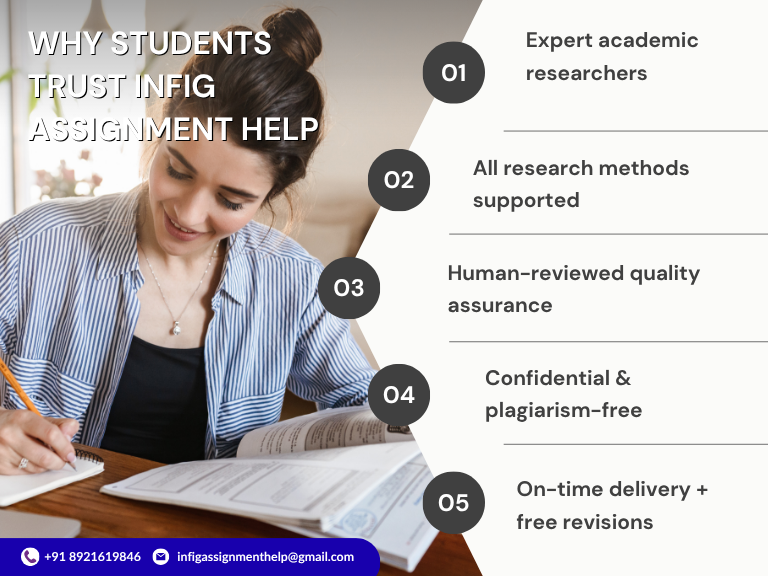
Why Students Choose Infig Assignment Help?
Students trust Infig Assignment Help because we combine academic expertise with a structured quality assurance process. Every project is handled with attention to detail, confidentiality, and university expectations.
Our advantages include:
Student Testimonials
Ready to Complete Your Dissertation Data Analysis with Confidence?
Frequently Asked Questions
What details do I need to provide before data analysis begins?
Please share your dissertation topic, research objectives, methodology, dataset, questionnaire or interview transcripts, supervisor instructions, and university guidelines. The more information you provide, the better we can tailor the analysis to your research.
Will I receive a detailed report explaining how the analysis was conducted?
Yes. We provide clear explanations of the analytical methods used, the statistical or qualitative findings, and how the results relate to your research questions and hypotheses.
Can I ask questions about the completed data analysis?
Absolutely. If you need clarification on the analysis, outputs, or interpretation, our experts are available to answer your queries and explain the results.
Can you complete dissertation data analysis within one day?
Urgent requests may be accommodated depending on the dataset size, research complexity, and software requirements. Contact us with your deadline, and we will assess the feasibility.
Will I receive the software output files?
Yes. Where applicable, we provide the original software output files along with tables, charts, and interpreted results so you have complete documentation of the analysis.
What are the five common types of data analysis in research?
The five widely used types are descriptive analysis, inferential analysis, diagnostic analysis, predictive analysis, and prescriptive analysis. The appropriate method depends on your research objectives and data type.
Can you help with both quantitative and qualitative data analysis?
Yes. We support quantitative, qualitative, and mixed-method dissertations using recognised analytical techniques and software appropriate to your research design.
Which statistical software do you use?
Our experts work with SPSS, R, Stata, SAS, AMOS, SmartPLS, Python, MATLAB, Excel, NVivo, MAXQDA, Jamovi, JASP, and other recognised analytical tools.
Can you help me choose the right statistical test for my dissertation?
Yes. After reviewing your research objectives, variables, sample size, and hypotheses, we recommend the most appropriate statistical tests for your study.
Is my research data kept confidential?
Yes. We treat all research documents, datasets, and personal information with strict confidentiality and use them solely for the purpose of providing the requested academic support.