
Writing a dissertation is challenging enough—but have you reached the stage where your university asks you to submit a dissertation ethics form? Unsure what information to include, how detailed your answers should be, or whether your research even requires ethical approval? If these questions sound familiar, you’re in the right place. This guide explains everything you need to know about completing an ethics form for dissertation, including its purpose, essential sections, writing tips, and practical examples.
What is a Dissertation Ethics Form?
A dissertation ethics form also known as ethical consent form is an official document submitted to a university’s research ethics committee before data collection begins. It explains how your research will be conducted, identifies any potential ethical risks, and demonstrates the measures you’ll take to protect participants, maintain confidentiality, obtain informed consent, and comply with accepted research ethics standards. Completing this form is often mandatory for dissertations involving human participants, personal data, interviews, surveys, observations, or sensitive information.
Dissertation Ethics Form – Importance and Purpose
An ethics form for dissertation is more than an administrative requirement. It ensures your research meets ethical, legal, and academic standards while protecting both participants and researchers throughout the study.
Some of the major purposes include:
1. Protects Research Participants
The ethics form demonstrates how participants will be treated fairly, respectfully, and without harm throughout the research process.
2. Ensures Informed Consent
Participants should understand the purpose of the study, how their information will be used, and their right to withdraw at any stage without consequences.
3. Maintains Privacy and Confidentiality
The form explains how personal information, interview recordings, survey responses, and research data will be securely stored and protected.
4. Identifies Potential Risks
Researchers must recognise any physical, psychological, emotional, social, or legal risks associated with their study and explain strategies to minimise them.
5. Demonstrates Research Integrity
Universities expect researchers to conduct honest, transparent, and responsible research. The ethics form confirms adherence to accepted ethical principles.
6. Complies with University Policies
Most universities require ethical approval before any participant recruitment or data collection begins. Failure to obtain approval may delay or invalidate the research.
7. Protects Vulnerable Groups
Research involving children, elderly individuals, patients, or other vulnerable populations requires additional ethical safeguards, which are documented in the ethics application.
8. Supports Credible Research Findings
Ethically conducted research improves the reliability, trustworthiness, and acceptance of dissertation findings within the academic community.
9. Prevents Legal and Ethical Violations
The ethics review process helps identify potential legal issues related to privacy, data protection, intellectual property, discrimination, or participant safety before research begins.
Key Components of a Dissertation Ethics Form
Although universities use different templates, most dissertation ethics forms include similar sections. Completing each section accurately improves the chances of receiving ethical approval without unnecessary revisions.
1. Research Project Details
Include the dissertation title, department, degree programme, supervisor’s name, and brief description of your research project.
2. Research Objectives
Clearly explain what your study aims to investigate and the academic problem it intends to solve.
3. Research Methodology
Describe the methods you will use, such as questionnaires, interviews, focus groups, experiments, case studies, observations, or mixed methods.
4. Participant Information
Specify who will participate in your study, including eligibility criteria, expected sample size, recruitment methods, and participant demographics.
5. Informed Consent Process
Explain how participants will receive study information and voluntarily agree to participate before any data collection begins.
6. Potential Risks
Identify any possible physical, psychological, emotional, financial, reputational, or privacy-related risks associated with the research.
7. Risk Mitigation Measures
Describe the precautions taken to reduce identified risks and ensure participant wellbeing throughout the study.
8. Confidentiality and Data Protection
Explain how participant identities will remain confidential and how research data will be securely stored, encrypted, accessed, and eventually destroyed.
9. Voluntary Participation
Confirm that participation is entirely voluntary and participants may withdraw from the study without penalty.
10. Ethical Considerations
Discuss issues such as anonymity, confidentiality, informed consent, data protection, conflict of interest, and participant welfare.
11. Researcher’s Declaration
The researcher signs a declaration confirming that all information provided is accurate and that the study will comply with institutional ethical guidelines.
How to Write an Ethics Form for Dissertation?
Writing a strong ethics form for dissertation requires accuracy, transparency, and careful planning. The information should be concise, realistic, and consistent with your dissertation proposal.
Step 1 – Understand Your University’s Ethics Guidelines
Before writing, carefully review your university’s ethics policy, application template, and submission requirements. Every institution follows slightly different approval procedures.
Step 2 – Describe Your Research Clearly
Provide a simple overview of your research objectives, research questions, methodology, and expected outcomes without using unnecessary technical language.
Step 3- Explain Why Ethical Approval is Needed
State whether your research involves human participants, personal information, interviews, surveys, observations, or sensitive topics requiring ethical review.
Step 4- Identify Your Participants
Clearly explain who will participate, how they will be recruited, why they were selected, and the approximate number of participants involved.
Step 5- Describe the Consent Procedure
Explain how informed consent will be obtained before participation. Mention participant information sheets, consent forms, and their right to withdraw at any time.
Step 6- Address Confidentiality
Describe how participant identities will remain anonymous, how personal information will be stored securely, and who will have access to the collected data.
Step 7- Assess Potential Risks
Identify possible risks for participants and explain practical measures taken to minimise emotional, psychological, physical, or privacy-related concerns.
Step 8- Explain Data Storage Procedures
Mention where research data will be stored, how long it will be retained, password protection measures, encryption methods, and secure disposal after project completion.
Step 9- Declare Compliance with Ethical Standards
Confirm that your research follows institutional ethics policies, data protection regulations, professional research standards, and supervisor guidance.
Step 10- Review Before Submission
Carefully proofread your ethics form to ensure consistency with your dissertation proposal, remove errors, and verify that all required supporting documents are attached.
Common Mistakes Students Make While Completing a Dissertation Ethics Form
Many ethics applications are returned for revision because students overlook important details. Avoiding these common mistakes can improve your chances of first-time approval.
- Providing vague or incomplete research objectives.
- Failing to explain participant recruitment methods.
- Ignoring potential ethical risks.
- Not describing confidentiality measures clearly.
- Forgetting to include informed consent procedures.
- Providing inconsistent information compared to the dissertation proposal.
- Missing required declarations or signatures.
- Underestimating data protection and storage requirements.
- Using copied or generic responses instead of project-specific explanations.
- Submitting the ethics form after starting data collection.
Best Practices for a Successful Ethics Application
To strengthen your ethics form dissertation example and improve approval chances, keep these recommendations in mind:
- Write honestly and transparently.
- Keep explanations concise but complete.
- Focus on participant safety and privacy.
- Align your ethics form with your research proposal.
- Follow your university’s formatting requirements.
- Consult your dissertation supervisor before submission.
- Double-check all supporting documents, including participant information sheets and consent forms.
- Allow enough time for revisions, as ethics approval can take several weeks.
Dissertation Ethics Form Sample
Understanding a dissertation ethics form example can make it easier to complete your own application. While every university has its own format, most ethics forms request similar information about your research, participants, data collection methods, and ethical considerations. The following sample demonstrates how a typical ethics form for dissertation example may be completed.
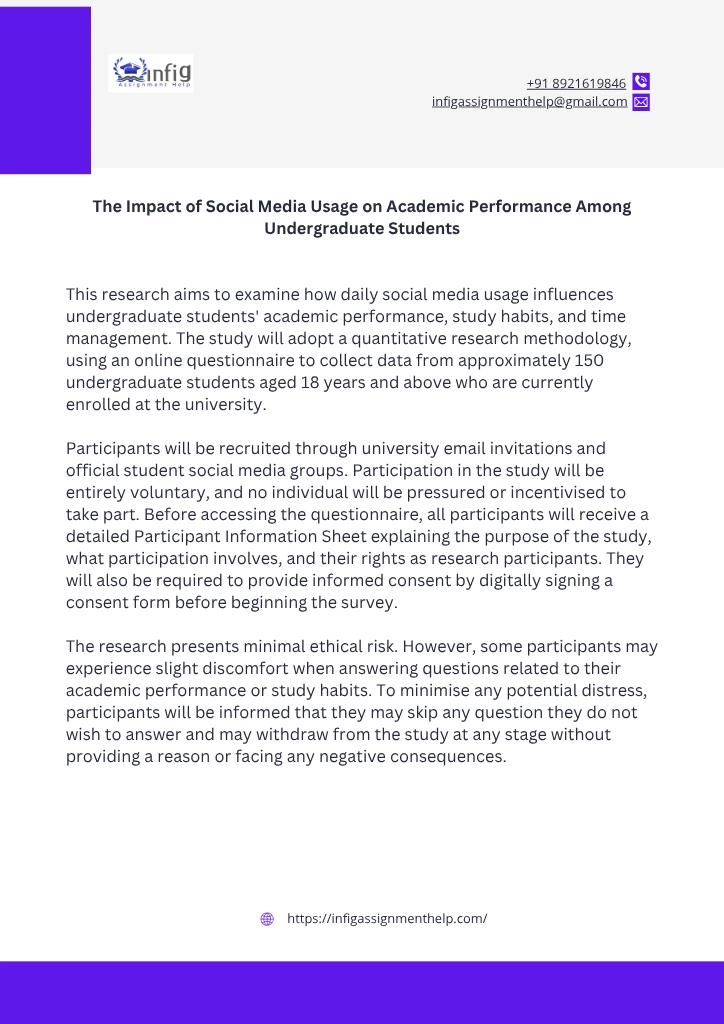
Research Title: The Impact of Social Media Usage on Academic Performance Among Undergraduate Students
This research aims to examine how daily social media usage influences undergraduate students’ academic performance, study habits, and time management. The study will adopt a quantitative research methodology, using an online questionnaire to collect data from approximately 150 undergraduate students aged 18 years and above who are currently enrolled at the university.
Participants will be recruited through university email invitations and official student social media groups. Participation in the study will be entirely voluntary, and no individual will be pressured or incentivised to take part. Before accessing the questionnaire, all participants will receive a detailed Participant Information Sheet explaining the purpose of the study, what participation involves, and their rights as research participants. They will also be required to provide informed consent by digitally signing a consent form before beginning the survey.
The research presents minimal ethical risk. However, some participants may experience slight discomfort when answering questions related to their academic performance or study habits. To minimise any potential distress, participants will be informed that they may skip any question they do not wish to answer and may withdraw from the study at any stage without providing a reason or facing any negative consequences.
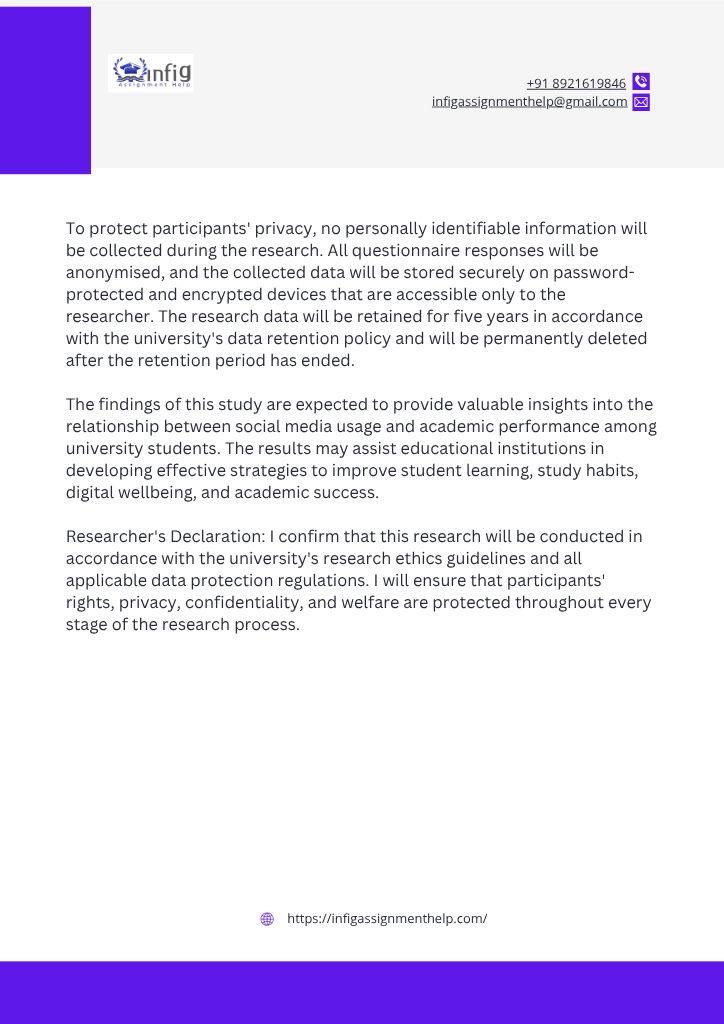
To protect participants’ privacy, no personally identifiable information will be collected during the research. All questionnaire responses will be anonymised, and the collected data will be stored securely on password-protected and encrypted devices that are accessible only to the researcher. The research data will be retained for five years in accordance with the university’s data retention policy and will be permanently deleted after the retention period has ended.
The findings of this study are expected to provide valuable insights into the relationship between social media usage and academic performance among university students. The results may assist educational institutions in developing effective strategies to improve student learning, study habits, digital wellbeing, and academic success.
Researcher’s Declaration: I confirm that this research will be conducted in accordance with the university’s research ethics guidelines and all applicable data protection regulations. I will ensure that participants’ rights, privacy, confidentiality, and welfare are protected throughout every stage of the research process.
Note: This is a general dissertation ethics form example for educational purposes. Always use your university’s official ethics application template and follow your institution’s ethical review requirements.
Tips to Submit Your Ethics Form for Dissertation
Submitting your ethics application correctly can reduce delays and increase the likelihood of approval. Consider these practical tips before sending your form to the ethics committee.
1. Read Your University’s Ethics Policy Carefully
Each university follows different ethical approval procedures. Review the official guidelines to ensure your application meets all institutional requirements.
2. Complete Every Required Section
Avoid leaving mandatory fields blank. Even if a section seems irrelevant, explain why it does not apply to your research.
3. Keep Information Consistent
Your research objectives, methodology, participant details, and ethical considerations should match your dissertation proposal and research plan.
4. Attach Supporting Documents
Include participant information sheets, consent forms, recruitment materials, questionnaires, interview schedules, or observation checklists if required.
5. Clearly Explain Participant Protection
Demonstrate how you will maintain confidentiality, protect personal information, minimise risks, and respect participants’ rights throughout the study.
6. Proofread Before Submission
Check for spelling mistakes, missing information, inconsistent responses, and formatting errors before submitting your application.
7. Obtain Supervisor Approval
Many universities require your dissertation supervisor to review or approve the ethics application before submission to the ethics committee.
8. Submit Early
Ethics approval may take several weeks depending on your institution. Submitting early helps avoid unnecessary delays in your dissertation timeline.
How Seeking Professional Help for Writing a Dissertation Ethics Form Can Help You
Completing a dissertation ethics form requires more than simply answering questions. It demands a clear understanding of research ethics, university expectations, participant rights, and legal responsibilities. Seeking professional guidance can help students prepare a well-structured and accurate ethics application while avoiding common mistakes.
At Infig Assignment Help, experienced academic professionals assist students in understanding ethical requirements and preparing comprehensive documentation that aligns with university guidelines. Professional dissertation writing help in dissertation ethics form can help you:
- Understand your university’s ethics approval requirements.
- Identify ethical issues relevant to your research topic.
- Prepare participant information sheets and informed consent forms.
- Describe research methodology clearly and accurately.
- Address confidentiality, anonymity, and data protection measures.
- Conduct an appropriate risk assessment for your study.
- Review your ethics application for completeness and consistency.
- Reduce the likelihood of revisions or rejection due to avoidable errors.
- Save valuable time while preparing dissertation documentation.
- Gain confidence before submitting your ethics application.
Professional guidance does not replace your original research; instead, it helps ensure your documentation is complete, ethical, and aligned with academic standards.
Conclusion
Congratulations on taking the time to understand the importance of a dissertation ethics form. A carefully prepared ethics application not only helps secure university approval but also demonstrates your commitment to responsible and ethical research practices. By understanding the purpose, key components, writing process, and reviewing a dissertation ethics form example, you can approach this stage of your dissertation with greater confidence.
Did this guide answer your questions about preparing an Ethics Form for Dissertation? Was this blog helpful in making the process easier to understand? We’d love to hear your feedback and suggestions so we can continue creating resources that support students throughout their dissertation journey.
FAQ
Is submitting a dissertation ethics form compulsory?
Yes. Most universities require students to obtain ethical approval before collecting research data, particularly when studies involve human participants, personal information, interviews, surveys, or observations.
What should I do if my dissertation ethics form is rejected?
Review the committee’s feedback carefully, revise the requested sections, discuss changes with your supervisor if necessary, and resubmit the updated ethics application for approval.
Can I begin collecting data before receiving ethics approval?
No. Data collection should only begin after formal ethical approval has been granted by your university. Collecting data beforehand may invalidate your research.
Can I design my own assignment cover page?
Yes, provided it meets your university’s formatting requirements. It should remain professional, clean, and free from unnecessary graphics unless specifically requested.
Does every dissertation require an ethics form?
Not always. Literature-based or systematic review dissertations often do not require ethical approval, while research involving participants, personal data, or sensitive information usually does.
How long does dissertation ethics approval usually take?
Approval timelines vary by university, but the review process typically takes between one and six weeks, depending on the complexity of the research and committee workload.
Can I modify my research after ethics approval?
Yes, but significant changes to your methodology, participants, or data collection process may require an amendment or additional approval from the ethics committee.
What documents should I submit with my ethics application?
Most universities require participant information sheets, informed consent forms, questionnaires, interview guides, recruitment materials, and any other documents related to participant involvement.
Can professional experts help me prepare my dissertation ethics form?
Yes. Professional academic experts can guide you in preparing accurate ethics documentation, identifying ethical considerations, and ensuring your application aligns with university research standards while keeping the work original.